What Is a Masseria? Puglia’s Traditional Farm Estates Explained

Key takeaways
• A masseria is a stone farm estate of southern Italy, built around a central courtyard where the landowner’s family, farmworkers and animals lived and worked together.
• Puglia’s surviving masserie mostly date from the 16th to 18th centuries, and many were walled and towered against raids by pirates and Ottoman forces.
• Today, the masserie that take guests run mainly as boutique hotels or agriturismi, where you book a room or suite and share the estate with other visitors.
What is a masseria?
A masseria (plural masserie) is a farm estate found across southern Italy, and Puglia is where they are most widespread. Each one gathered the landowner’s house, the workers’ quarters and the stables around a central courtyard, so the whole farm ran from one place. The name comes from massaro, the farm manager who ran the estate and brought in the harvest.
Many were fortified, too. Raids by pirates, Ottoman forces and bandits were a constant threat, so wealthy landowners ringed their farms with high walls and watchtowers. Those walled estates are the masserie most people picture today, while smaller farms often made do with lighter defences.
Where the masseria tradition comes from
Many masserie started life as a single watchtower. Landowners built rooms, stables and storerooms around it over the generations, until the estate grew into a small village producing olive oil, wine, cheese and grain. Most of the ones you see today went up when landowners resettled and farmed the empty interior of the region.
From the late 17th century, people slowly left the countryside for the towns. A few estates became family summer houses; many more fell into ruin. Restoration took off in the 1990s, and today you can stay in hundreds of them.
What a masseria looks like
Walk into a masseria and you’ll notice the walls first. The local limestone is laid so thick that the rooms stay cool through a Puglian August, and the small, deep-set windows are a leftover from the days of keeping raiders out.
Look up and you’ll often find vaulted stone ceilings, from plain barrel curves to the volta a stella, a star vault whose edges meet in a star shape overhead. Outside, every building opens onto the courtyard. This was the working heart of the farm, used for threshing grain, sorting the harvest and penning animals.
Bigger estates added a chapel, rainwater cisterns and a bread oven, so they never had to rely on the nearest town. Before you head inside, check above the main gate for the caditoie: small openings that let defenders drop stones on unwelcome visitors.
Masseria vs. Trullo: What’s the Difference?
A masseria and a trullo often share the same olive-covered landscape in the Valle d’Itria, but they differ in size, construction and purpose.
Masseria
The masseria is the big one: several stone buildings, laid with mortar and joined around a courtyard, built to farm the land at scale and often to defend it. If you see a long boundary wall with a single wide gateway and a tower rising behind it, you’re looking at a masseria.
Trullo

The trullo is the small one: usually one or two rooms under a conical roof, built from dry stone with no mortar. Farmworkers and smallholders used trulli as homes, storerooms and shelters in the fields.
Why no mortar? Local tradition says it was about tax. New settlements in the Kingdom of Naples owed the crown a tribute, so the counts who ruled Alberobello are said to have had their peasants build homes that could be pulled down quickly before an inspector arrived.
Alberobello’s trulli are now a UNESCO World Heritage Site. To see them at their densest, wander the lanes of the Rione Monti quarter, where around a thousand line the streets.
Where to find masserie in Puglia
You’ll find masserie all over Puglia, but the best-known cluster in the Valle d’Itria, on the coastal plain around Fasano and Monopoli, and down in Salento. Landowners built wherever the land could feed a large estate, so most sit among olive groves and vineyards. Many are reached by narrow country lanes, so if you plan to visit a few, read our guide to driving in Puglia before you go.
What staying in a masseria looks like today
Most masserie that take guests now run as boutique hotels, B&Bs or agriturismi. Because the estates are large, owners divide them into rooms and suites, so you’ll share the courtyard, pool and restaurant with other guests. The food is often the highlight: many still make their own olive oil and wine, and dinner tends to feature what the estate grows.
Stay in Puglia’s traditional stone architecture with Puglia Luxury Homes
Most people book a masseria for the cool stone rooms, the olive groves outside the window and the slow pace of country life. Puglia Luxury Homes doesn’t rent masserie, but our villas around Ostuni and the Valle d’Itria are built from the same stone and traditions, and the whole property is yours for the stay. These three come closest to the masseria feel, and you can browse the rest of our villas in Puglia.

If you’re travelling as a big group, Villa Arteviva has the layout closest to a masseria. Three restored stone buildings share seven hectares of olive groves above Ostuni, including a former farmhouse with star-vaulted ceilings set around a private courtyard. Up to 20 guests can spread out across 9 bedrooms, with a 16-metre pool between the buildings. Choose the Fully Staffed option and a team cooks lunch and dinner for you every day.
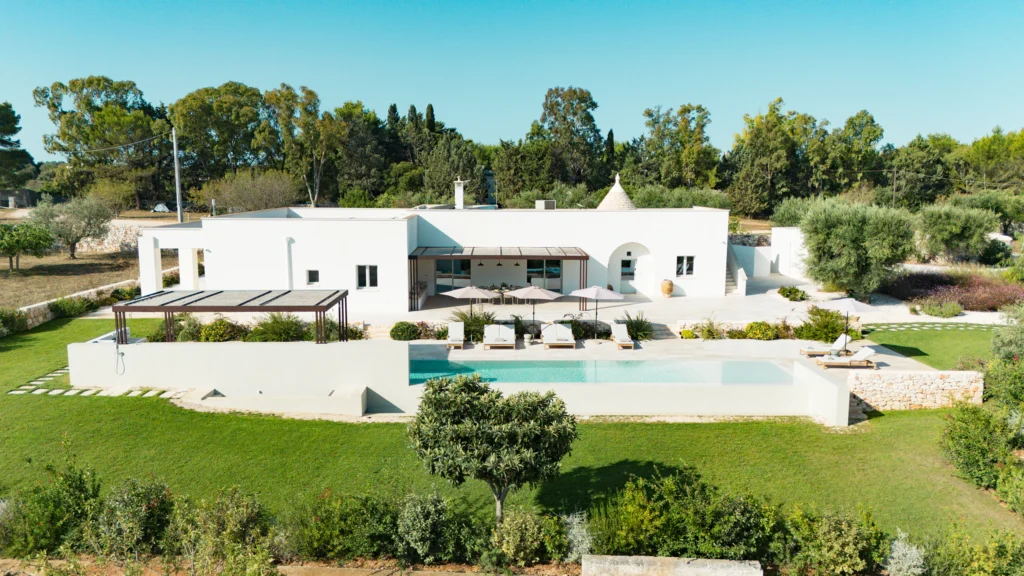
For a family or a close group of up to 12, Villa Elisabetta offers a historic trullo that has been passed down through generations and restored in 2024. Stone vaults keep the rooms cool, and the infinity pool looks out over a hectare of century-old olive trees. Valentina, our local partner, meets you on arrival, and Ostuni, Locorotondo and Cisternino are all a short drive away.

Villa Caterina is the one for garden lovers. Owner Elena Labriola restored this 18th-century trulli complex and planted a garden of medicinal and aromatic herbs around it. You can move between two pools, one an infinity pool facing the fields, while a housekeeping and kitchen team looks after the house each day. It sleeps up to 12 in 6 bedrooms.
What a private villa stay with Puglia Luxury Homes includes
With no other guests around, the pool, the terraces and the olive groves are yours for the whole stay. Our concierge team can bring in a private chef, set up a wine tasting or book a boat day on the Adriatic. When you’re ready to compare sizes and dates, the full villa collection is the place to start.
FAQs
What’s the difference between a masseria and a trullo?
A masseria is a farm complex of several stone buildings laid with mortar around a courtyard, built to run an agricultural estate. A trullo is a small single dwelling built from dry stone with a conical roof, used by farmworkers as a home, storeroom or field shelter.
Can you rent a masseria in Puglia?
Yes. Most masserie that take guests run as boutique hotels or agriturismi, where you book a room or suite and share the estate’s facilities with other guests. For a private stay in a similar setting, a restored trullo or stone farmhouse villa gives your group the whole property.
Is a masseria the same as an agriturismo?
No. A masseria is a type of building, while an agriturismo is a type of business. Under Italian law, an agriturismo is hospitality offered by a farmer and connected to the farm’s own agricultural activity. Many masserie operate as agriturismi today, and others run as hotels without a working farm.
Are trulli and masserie found in the same part of Puglia?
They overlap in the Valle d’Itria, where masserie stand among olive groves dotted with trulli. Trulli cluster most densely around Alberobello, Locorotondo, Cisternino, Martina Franca and the countryside near Ostuni. Masserie spread much further, across the provinces of Bari, Brindisi, Taranto and Lecce and the Capitanata plain in the north.